

The High-Altitude Arrival of the Colorado Stampede
Professional spring football has returned to Colorado, and it arrived with a plan rather than a prayer. The Colorado Stampede enter the United Football League as its newest expansion franchise, and they do so carrying something almost no startup club has ever possessed: a complete, functioning football operation on day one. Head coach Rick Neuheisel will lead the Stampede, bringing his coaching staff and roster pieces over from the 2026 Dallas Renegades.
Weidner Field sits at an elevation of 6,035 feet — significantly higher than most professional football venues.
That number is the franchise’s thesis statement. The move to Colorado Springs rather than Denver gives the UFL a distinct mountain-market identity and marks the first professional spring football team in the state since the Denver Gold (1983–1985). The Stampede also hold the 2nd overall pick in the First Round and the 4th pick in the Second Round of the 2027 UFL Draft, meaning they inherit a veteran core and still get to shop at the top of the board. Few expansion clubs in any league have entered with that combination of continuity and capital.
Inheriting Excellence: The Dallas Renegades Connection
Expansion franchises usually begin as collections of other teams’ leftovers. The Stampede are an exception. The decision to relocate the Dallas Renegades’ football infrastructure — staff, systems, and roster pieces — into Colorado Springs sidesteps the slow, painful assembly period that historically defines a league’s newest club.
Continuity of this kind is the real asset. Playbooks don’t require rebuilding, position coaches already know which players fit which concepts, and the install schedule in training camp starts from a known baseline rather than from zero. In a spring league with compressed preparation windows, that head start is measured in weeks, not days.
Contrast this with the traditional model, where an expansion club drafts unprotected players from seven rosters, hires a staff that has never worked together, and spends its first season discovering its own identity in public. The Stampede skip that phase entirely. What arrives in Colorado isn’t a blank slate — it’s a team with established habits, now playing a mile-plus above the ones it used to face.
From Denver Gold to Colorado Stampede: A Historical Legacy
Colorado’s spring football story has a long gap in the middle. The Denver Gold competed in the original USFL from 1983 through 1985, building a loyal following before the league’s collapse ended the experiment. For four decades afterward, the state sat out the spring game entirely. The Stampede represent the first professional spring football team in Colorado since that Gold era — a lineage that researchers and collectors have waited a very long time to extend.
Then vs. Now:
- Then: Denver, a major metro anchored by Mile High Stadium and the shadow of an NFL incumbent.
- Now: Colorado Springs, a mid-market city where the franchise is the headline act rather than the opening band.
- Then: USFL branding built around precious-metal nostalgia and 1980s civic boosterism.
- Now: Stampede branding built around regional identity, altitude, and Western imagery.
That distinction matters for anyone cataloging the state’s football record. The Stampede are not a Gold revival, a tribute club, or a relocation of old intellectual property. They are a separate entity beginning a separate timeline, and conflating the two erases what makes each one historically interesting.
Strategic Drafting for the 2027 Season
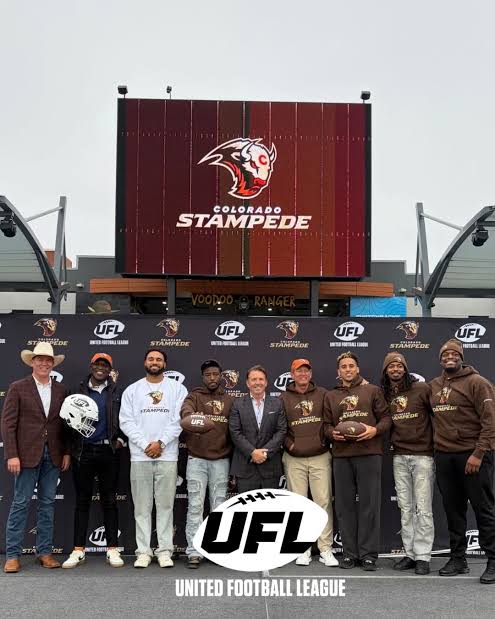
Inheriting a roster addresses depth. It does not automatically solve talent at the top. That’s where the Stampede’s draft position plays a crucial role in their strategy.
| Asset | Position |
|---|---|
| First Round | 2nd overall pick |
| Second Round | 4th pick |
| Draft cycle | 2027 UFL Draft |
Picking second in the opening round gives Neuheisel access to a premium prospect without the pressure of setting the board. More valuable still is the pairing: an early first-rounder followed closely by an early second-rounder means two high-quality additions before most rivals have made their second selection.
The relocated Dallas roster already covers the middle of the depth chart, so these picks are not survival tools — they’re surgical. A staff that has spent a full season evaluating its own personnel knows precisely which positions underperformed and can target them directly. That is a luxury expansion teams almost never enjoy. Longer term, it also lets Neuheisel build toward the specific demands of a high-altitude home schedule rather than drafting generically for a league-average environment.
The Weidner Field Advantage: Altitude as a Weapon
Thin air changes football. At elevation, reduced oxygen availability increases perceived exertion, lengthens recovery time between snaps, and punishes conditioning deficits that go unnoticed at sea level. A visiting defense on a long drive in the fourth quarter feels the effects more than the home unit, which is acclimated through months of practice.
Weidner Field’s 6,035-foot elevation is significantly higher than most professional football venues.
Lower air density also affects ball flight. Kicks travel farther, which expands field-goal range and alters fourth-down decision-making. Deep passing balls carry differently, rewarding quarterbacks and receivers who have calibrated their timing in that environment and frustrating those seeing it for the first time in a single road trip.
For bettors and analysts tracking early franchise indicators, this is exactly the kind of structural variable worth monitoring: home/road splits, second-half scoring differentials, and special-teams performance at Weidner Field football games will reveal whether the altitude edge is real or merely theoretical. In Colorado Springs — a city built around altitude and Olympic-level training culture — the stadium fits the civic identity as naturally as the team name does.
What You Need to Know: The Stampede Essentials

For readers tracking the Colorado UFL team’s launch, here are the essentials in their simplest form:
- The franchise begins competitive play in 2027, with football operations, staffing, and roster work underway in the preceding months — meaning the organization exists well before its first kickoff.
- Head coach Rick Neuheisel leads the Stampede, carrying over his coaching staff and roster pieces from the Dallas Renegades, which makes this one of the few expansion clubs in spring football history to begin with an intact football operation.
- Home games are played at Weidner Field in Colorado Springs at 6,035 feet, an elevation that distinguishes the venue from nearly every other stop on the UFL schedule and gives the Stampede a measurable environmental edge.
- The team holds elite draft capital, headlined by the 2nd overall selection, allowing it to add premium talent on top of an already established depth chart rather than rebuilding from nothing.
Together, these four factors explain why Colorado Stampede football is being treated as a strategic construction rather than a conventional league addition.
Preserving the Stampede’s Place in Sports History
The UFL expansion that brought the Stampede to Colorado Springs should be documented from its inception, not just from its first championship. Franchise histories are hardest to reconstruct at the beginning, when primary materials — launch-day logos, inaugural uniform sets, early merchandise runs, press releases, and the first printed Colorado Stampede tickets — circulate briefly and then disappear into private collections. The archival record of the Denver Gold is thinner than it should be for exactly that reason.
Collectors and researchers have a narrow window here. Inaugural-season material is produced in limited quantities and rarely reissued, and branding often shifts within the first few years as a club refines its visual identity. Capturing the original marks, wordmarks, and color treatments now establishes a baseline for measuring future revisions.
Sportsteamhistory.com maintains the timelines, logo evolutions, and franchise records that turn scattered artifacts into a coherent history. Follow the Stampede’s entry as it develops, and document the 2027 season while it’s happening — because the chapter being written in Colorado Springs is one that future researchers will want in full.