
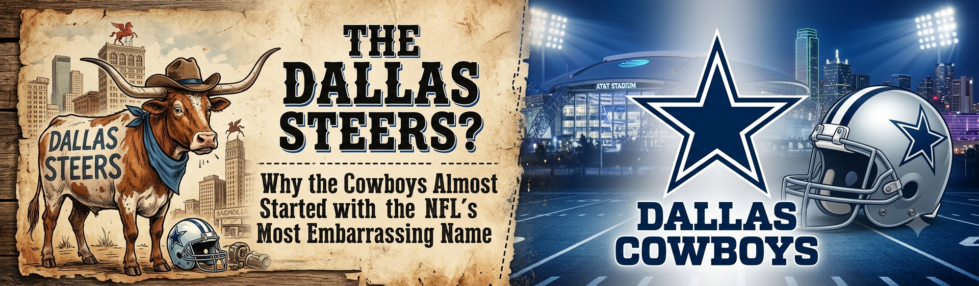
The 1960 Expansion: A Franchise Without a Face
Much like the high-stakes environment of online casinos, the 1960 NFL expansion was a massive gamble for all involved. Before the Dallas Cowboys became “America’s Team,” they almost launched under a name so awkward it might have defined them for the wrong reasons entirely. The Dallas Cowboys’ original name was never a settled matter — it was the product of a chaotic, compressed timeline that left almost no room for careful thinking. The history of the Dallas Steers and the brief identity of the Dallas Rangers NFL team are key chapters in this tumultuous naming journey.
Before the Dallas Cowboys became “America’s Team,” they almost launched under a name so awkward it might have defined them for the wrong reasons entirely. The Dallas Cowboys’ original name was never settled — it was the product of a chaotic, compressed timeline that left almost no room for careful thought. The history of the Dallas Steers and the brief identity of the Dallas Rangers NFL team are key chapters in this tumultuous naming journey.
The Dallas Cowboys were founded in 1960 as an NFL expansion team, entering a market already claimed by the AFL’s Dallas Texans. The league was locked in an aggressive territorial battle with the AFL, and establishing a foothold in Dallas was a strategic priority. Speed mattered more than polish.
Owner Clint Murchison Jr. secured the franchise late in the process, which meant everything — the roster, the coaching staff, the identity — had to be assembled under genuine pressure. As Murchison reportedly put it at the time: “We were building the plane while flying it.” There was simply no runway for the kind of deliberate brand-building that defines a franchise for generations.
The result was a branding process driven by urgency rather than vision. The organization needed a name, a logo, and a uniform before the season opened — survival came first. And that rush produced at least one decision that almost became a lasting embarrassment, a name that the team’s own general manager could not stomach the moment he heard it.
The Dallas Steers: The Name Tex Schramm Hated
The Dallas Steers’ history is one of the NFL’s shortest and most cringe-worthy chapters — a name that was dead on arrival before the team ever played a single down.
When the franchise was officially announced as the Dallas Steers, the reaction from team leadership was not enthusiastic. It was an immediate, visceral objection. General Manager Tex Schramm hated the name from the moment it surfaced. His reasoning was blunt and biological: a steer is not a bull. It is not a symbol of raw power or dominance. It is, by definition, a castrated male bovine — an animal specifically bred to be docile and controllable.
Steer (noun): A castrated male bovine, typically raised for beef rather than breeding. The castration removes the animal’s testosterone-driven aggression, making it easier to manage — and far less intimidating.
That definition alone tells you everything about why Schramm pushed back so hard. According to The Sports Chief, Schramm believed the name projected a fundamental lack of virility and strength — precisely the opposite of what a professional football franchise needed to communicate. In a sport built on toughness and aggression, naming your team after a neutered animal was not a quirky, bold choice. It was, in Schramm’s view, an embarrassment waiting to happen.
And so the name had to go. But what came next was hardly a smooth fix — the replacement name brought an entirely different set of problems.
The Dallas Rangers: A Brief and Legally Perilous Identity
The Dallas Rangers NFL team identity lasted barely long enough to print letterhead — a second naming failure that exposed just how chaotic the Cowboys’ pre-season identity crisis had become.
After the Dallas Steers’ name collapsed under the weight of its own awkwardness, management pivoted to “Rangers,” leaning into the rugged, frontier-lawman imagery that Texas pride seemed to demand. On paper, it felt like progress. But the name carried a problem that no amount of frontier mystique could solve: it was already taken.
A local minor league baseball team operated under the Dallas Rangers banner, actively competing for fans’ attention and dollars in the same market. The overlap was not just inconvenient — it was a legal exposure waiting to happen. Trademark conflicts in professional sports can trigger injunctions, force costly rebranding mid-season, and, perhaps most damaging of all, generate exactly the kind of negative press a brand-new franchise cannot afford. Management recognized quickly that building an identity on contested ground was a risk the organization could not absorb.
Naming a team is a legal act as much as a creative one, and the Rangers episode made that lesson painfully clear. The front office needed something original, something rooted in Texas culture but entirely unclaimed. That search — urgent, pressure-filled, and running out of calendar — would finally lead them toward the name that stuck.
Settling on the Cowboys: The Third Choice Becomes a Legend
After two failed attempts at naming, the right answer turned out to be hiding in plain sight — rooted in the land, the culture, and the mythology that Texas had been building for generations.
The name “Cowboys” was officially adopted on March 19, 1960, giving the franchise just enough time to establish an identity before its inaugural season kicked off. It was the third choice, but it immediately felt like the only choice. Where the Steers stumbled into unintended comedy and the Rangers walked straight into a legal minefield, the Cowboys landed with effortless authority.
Tex Schramm’s branding instincts were sharp enough to recognize what the name offered that the previous candidates could not. Cowboys carried the full weight of the Old West mythos — independence, toughness, and a distinctly Texan swagger that no other NFL market could credibly claim. Schramm understood that a franchise name is not just a label; it is a long-term identity investment. Three factors made the Cowboys the clear winner:
Cultural resonance: The cowboy archetype was already woven into the Texas identity, connecting the team to something larger and older than professional football.
Competitive distinction: The name did not conflict with AFL franchises or any established Dallas baseball club, keeping the legal landscape clean.
National appeal: Cowboys translated well beyond Texas — evoking American mythology that resonated coast to coast.
Of course, a powerful name only carries a franchise so far. What the Cowboys still needed in 1960 was an actual roster capable of competing — and that challenge proved far more complicated than settling on the right words.
The Expansion Draft: Building a Team of ‘Leftovers’
The 1960 Dallas Cowboys entered the NFL not with a carefully assembled roster, but with a patchwork collection of players no other franchise wanted to keep.
Late franchise approval created an immediate structural disadvantage. Because the Cowboys were not formally approved in time to participate in the 1960 NFL Draft, they had no access to the pool of incoming college talent. Every other team in the league had already selected its prospects. Owner Clint Murchison Jr., whom Dallas Cowboys fans now revere, had to build a competitive roster from scratch through a separate expansion draft — a process that gave established franchises the opportunity to protect their best players and expose only their least valuable ones.
In practice, that meant Dallas received a roster built almost entirely from players on the outer edge of other teams’ depth charts. Aging veterans, injured prospects, and players who had not cracked a starting lineup elsewhere suddenly became the foundation of an NFL franchise. It was a structural disadvantage baked into the franchise’s very first season.
The result was as difficult as you might expect. The Cowboys finished their inaugural 1960 season with a record of 0-11-1, making them one of the least successful expansion teams in league history. And yet, that painful beginning also laid the groundwork for something remarkable — a timeline of decisions, both naming and organizational, that shaped everything that followed.
What You Need to Know: The Dallas Cowboys Naming Timeline
The Dallas Cowboys are the only NFL team to have cycled through three official names before playing a single regular-season game — a distinction that makes their branding journey unlike anything else in professional football history.
If you have ever wondered why the Dallas Cowboys were almost called the Steers, the answer comes down to one executive’s instinct for optics. When the franchise was first organized in 1960, the name “Dallas Steers” was the working title on the books. General Manager Tex Schramm shut it down quickly, reasoning that a castrated bull sent the entirely wrong message to a team trying to project toughness and ambition. The rejection was less about aesthetics and more about symbolism — and Schramm understood the two were inseparable.
The renaming process moved fast, but not fast enough to avoid a second stumble. The franchise pivoted to the Dallas Rangers, only to discover that a local minor league baseball club already held that name in the regional consciousness. Confusion in the marketplace was a real concern, and the name was quietly set aside.
Here is a condensed look at how the timeline unfolded:
Dallas Steers — the original registered name, rejected over mascot concerns
Dallas Rangers — the brief middle option, abandoned due to conflict with a local baseball team
Dallas Cowboys — officially adopted in March 1960, months ahead of the first kickoff
That compressed, three-name sequence is worth sitting with. According to Sportsteamhistory.com, no other NFL franchise shares that distinction. Each name change reflects a real-time lesson in how brand identity shapes perception — a lesson the Cowboys absorbed early and applied well. The name they eventually landed on would carry far more weight than anyone in that front office could have predicted heading into their inaugural season.
The Legacy of the Name: From Third Choice to America’s Team
What began as a branding embarrassment became one of the most recognizable franchises in professional sports history. The naming struggle the Cowboys endured during their 1960 founding offers a remarkable lens for understanding how much identity matters in the early stages of any organization — and how a near-miss can quietly shape an entire legacy.
The broader NFL expansion history of 1960 is filled with cautionary tales about franchises that launched without a coherent identity and paid the price in fan engagement for years. The Cowboys were nearly one of those teams. Had “Steers” stuck, or had the franchise continued cycling through placeholder names, it is difficult to imagine the same cultural gravity building around a neutered, directionless brand. The name “Cowboys” gave the franchise a mythology before it had a single winning season to its name.
That mythology compounded over the following decade. By the time NFL Films producer Bob Ryan famously labeled the team “America’s Team” ahead of the 1979 season highlight reel, the Cowboys’ name was already doing enormous cultural work. As Texas Monthly has noted, the Dallas Cowboys’ name has become synonymous with Texas pride and NFL dominance, despite its rocky start. A team called the Steers would not carry that weight. The cowboy archetype — rugged, independent, quintessentially American — translated directly into the moniker that would define the franchise for generations.
Branding decisions made in haste, under league pressure, and amid organizational chaos ultimately pointed toward something that resonated far beyond Texas. And that is worth sitting with. If you want to explore more team naming “what-ifs” — the franchises that almost wore a different identity forever — the Sports Team History database is the place to start.