
NBA · Seattle · 1967–2008
Seattle SuperSonics
Team History
Seattle SuperSonics history runs from 1967 to 2008. The Sonics won the 1979 NBA championship, reached three NBA Finals and moved to Oklahoma City in 2008, where the franchise became the Thunder.
The team
- Years
- 1967–2008
- City
- Seattle
- League
- NBA
What came next
- 2008
- Moved to Oklahoma City
How the SuperSonics Got Their Name
Named: 1967 · How: Chosen by owner Sam Schulman · Honoring: Seattle’s aviation industry and Boeing’s SST project
The NBA awarded Seattle a team on December 20, 1966, to a group led by Sam Schulman and Eugene V. Klein. The name SuperSonics was announced on January 11, 1967.
Schulman picked the name for Seattle’s ties to aviation, including Boeing’s recent contract for a supersonic transport (SST) project. Fans and the team often shortened it to the Sonics.
When the team moved to Oklahoma City in 2008, the settlement with Seattle kept the SuperSonics name, logo and colors in Seattle for a future NBA team, and the franchise became the Oklahoma City Thunder.
The Seattle SuperSonics Story
Six chapters, from the 1967 expansion team to the 2008 move. The dates and details for each one are in the timeline and tables below.
Chapter 1 · 1967–1972
Seattle SuperSonics Origin
23–59Record in 1967–68, Seattle’s first NBA season
The SuperSonics began play on October 13, 1967, at the Seattle Center Coliseum, one of two expansion teams that year with the San Diego Rockets. Al Bianchi coached the first two seasons.
Seattle traded for Lenny Wilkens in 1968, and he became player-coach in 1969. Spencer Haywood joined from the ABA in 1970 after a court fight that changed the NBA’s eligibility rules.
Defining moment1970: Spencer Haywood joins the Sonics, and his lawsuit opens the NBA to early entry.
Key figures: Sam Schulman, Al Bianchi, Lenny Wilkens, Spencer Haywood, Bob Rule
Chapter 2 · 1972–1977
Bill Russell’s Sonics
1975Year of Seattle’s first playoff trip
Bill Russell became coach and general manager in 1973, bringing a new defensive focus.
The Sonics reached the playoffs for the first time in 1975 and won a first-round series against Detroit. Fred Brown, nicknamed “Downtown,” became a fan favorite.
Defining moment1975: Seattle wins its first playoff series.
Key figures: Bill Russell, Spencer Haywood, Fred Brown, Slick Watts
Chapter 3 · 1977–1980
Back-to-Back Finals and the 1979 Title
4–1Finals win over the Washington Bullets in 1979
Lenny Wilkens returned as coach after a 5–17 start in 1977–78, and the Sonics finished 47–35 and reached the NBA Finals, losing to Washington in seven games.
Playing in the Kingdome, Seattle beat the Bullets 4–1 in the 1979 rematch. Dennis Johnson was named Finals MVP, with Gus Williams, Jack Sikma and Fred Brown alongside him.
Defining momentJune 1, 1979: the Sonics win Game 5 at Washington to clinch the NBA title.
Key figures: Lenny Wilkens, Dennis Johnson, Gus Williams, Jack Sikma, Fred Brown
Chapter 4 · 1980–1989
Ackerley and the 1987 Surprise
39–43Record of the 1986–87 team that reached the Western Conference Finals
Barry Ackerley bought the team from Sam Schulman in 1983, and the Sonics returned to the Coliseum in 1985. Wilkens left after the 1984–85 season.
Under Bernie Bickerstaff, a 39–43 team led by Tom Chambers, Dale Ellis and Xavier McDaniel beat Dallas and Houston to reach the 1987 Western Conference Finals.
Defining moment1987: a team with a losing record reaches the conference finals.
Key figures: Barry Ackerley, Bernie Bickerstaff, Tom Chambers, Dale Ellis, Xavier McDaniel
Chapter 5 · 1989–1998
Payton, Kemp and the 1996 Finals
64–18Record in 1995–96, the best in franchise history
Seattle drafted Shawn Kemp in 1989 and Gary Payton in 1990, and George Karl became coach in 1992. The 1993–94 Sonics won 63 games but became the first top seed to lose to an eighth seed, falling to Denver.
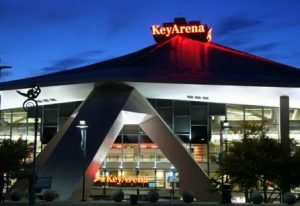
Two years later Seattle won 64 games and reached the NBA Finals, losing to the Chicago Bulls in six games. The team played 1994–95 in the Tacoma Dome while the Coliseum was rebuilt as KeyArena.
Defining moment1996: Seattle reaches its third NBA Finals.
Key figures: Gary Payton, Shawn Kemp, George Karl, Detlef Schrempf, Nate McMillan
Chapter 6 · 1998–2008
The Final Decade
41Seasons the franchise played in Seattle
Howard Schultz’s Basketball Club of Seattle bought the team in 2001, and Ray Allen arrived in a 2003 trade for Payton. Allen and Rashard Lewis led the Sonics to the 2005 division title.
Schultz sold the team in 2006 to Clay Bennett’s Oklahoma City group. Seattle drafted Kevin Durant in 2007, and after the 2007–08 season a settlement with the city let the team move, while the SuperSonics name, logo and colors stayed in Seattle.
Defining momentApril 13, 2008: the SuperSonics play their last game in Seattle.
Key figures: Howard Schultz, Ray Allen, Rashard Lewis, Clay Bennett, Kevin Durant
Seattle SuperSonics Timeline
Key moments in Seattle SuperSonics history, oldest first. Select any event for the full story.
Seattle Supersonics Team Formation
On December 20, 1966, Los Angeles businessmen Sam Schulman and Eugene V. Klein and a group of minority partners were awarded the NBA franchise for the city of Seattle. Schulman would serve…
Read the full story about Seattle Supersonics Team Formation →Spencer Haywood Joins the Sonics
Spencer Haywood, the ABA’s MVP with the Denver Rockets, signed with Seattle in December 1970. The NBA said Haywood could not play because his college class had not graduated. Haywood and owner…
Read the full story about Spencer Haywood Joins the Sonics →Wilkens Leads Seattle to the Finals
Lenny Wilkens took over as coach after a 5–17 start in 1977–78. The Sonics finished 47–35, then beat the Lakers, Portland and Denver to reach the NBA Finals. Seattle lost the Finals…
Read the full story about Wilkens Leads Seattle to the Finals →SuperSonics Win the 1979 NBA Title
NBA Finals - 1979 The 1979 NBA World Championship Series at the conclusion of the 1978 - 1979 season were won by the Seattle SuperSonics defeating the Washington Bullets 4 games to…
Read the full story about SuperSonics Win the 1979 NBA Title →Barry Ackerley Purchases Sonics
In October 1983, original team owner Sam Schulman sold the SuperSonics to Barry Ackerley, initiating a period of decline and mediocrity for the franchise. 1984 saw Fred Brown retire after playing 13…
Read the full story about Barry Ackerley Purchases Sonics →A 39–43 Team Reaches the Conference Finals
The 1986–87 Sonics finished 39–43 and entered the playoffs as the seventh seed in the West. Led by Tom Chambers, Dale Ellis and Xavier McDaniel, Seattle beat second-seeded Dallas and then Houston.…
Read the full story about A 39–43 Team Reaches the Conference Finals →63 Wins and an Upset Loss
Gary Payton and Shawn Kemp led the 1993–94 Sonics to a 63–19 record, the best in the NBA. Seattle lost its first-round series to eighth-seeded Denver in five games, the first time…
Read the full story about 63 Wins and an Upset Loss →64 Wins and the NBA Finals
The 1995–96 Sonics went 64–18, the best record in franchise history, under coach George Karl. Seattle beat Sacramento, Houston and Utah to reach its third NBA Finals. The Sonics lost the Finals…
Read the full story about 64 Wins and the NBA Finals →Ray Allen Arrives in Seattle
In February 2003 Seattle traded Gary Payton to Milwaukee in a deal that brought back Ray Allen. Allen teamed with Rashard Lewis, and the 2004–05 Sonics won 52 games and the Northwest…
Read the full story about Ray Allen Arrives in Seattle →Schultz Cannot Get a New Arena
Schultz is the former owner of the NBA's Seattle SuperSonics. During his tenure as team owner, he was criticized for his naïveté and propensity to run the franchise as a business rather…
Read the full story about Schultz Cannot Get a New Arena →Sonics Sold to Clay Bennett’s Group
From 2001 to 2006, Starbucks CEO Howard Schultz was the majority owner of the team, along with 58 partners or minor owners, as part of the Basketball Club of Seattle LLP. On…
Read the full story about Sonics Sold to Clay Bennett’s Group →Drafting of Kevin Durant
On May 22, 2007, the SuperSonics were awarded the 2nd pick in the 2007 NBA Draft, equaling the highest draft position the team has ever held. They selected Kevin Durant out of…
Read the full story about Drafting of Kevin Durant →The Last Season in Seattle
The SuperSonics played their last game in Seattle on April 13, 2008. In July 2008 the team’s owners reached a settlement with Seattle that let the franchise move to Oklahoma City. The…
Read the full story about The Last Season in Seattle →






NBA Championship History
Seattle played in three NBA Finals and won the 1979 title. The Sonics also reached the Western Conference Finals in 1980, 1987 and 1993.
| Season | Series | Opponent | Games | Result |
|---|---|---|---|---|
| 1995–96 | NBA Finals | CHI | 2–4 | Lost |
| 1978–79 | NBA Finals | WAS | 4–1 | Won |
| 1977–78 | NBA Finals | WAS | 3–4 | Lost |
Series results are listed Seattle first.
Seattle SuperSonics Legends
Retired Numbers
The banners for these numbers stayed in Seattle under the 2008 settlement. The Thunder’s No. 4 for Nick Collison is on the Oklahoma City Thunder page.
You Pick: Who Is the Greatest Seattle SuperSonic?
To qualify as the greatest player for this team, the player must have played one season for this team. If not, we will remove the player.
* verifies that player has played for this team as an added player by a fan.
Seattle SuperSonics Hall of Famers
Naismith Basketball Hall of Famers who played or coached for the SuperSonics in Seattle.
Seattle SuperSonics Logos
Every SuperSonics logo, from the 1967 original to the 2002–2008 design, is covered on our sister site, Sports Logo History.

See the complete SuperSonics logo history →
Seattle SuperSonics Arenas, Coaches and Owners History
Arenas
| Years | Arena |
|---|---|
| 1995–2008 | KeyArena |
| 1994–1995 | Tacoma Dome |
| 1985–1994 | Seattle Center Coliseum |
| 1978–1985 | Kingdome |
| 1967–1978 | Seattle Center Coliseum |
Head Coaches
| Years | Head Coach |
|---|---|
| 2007–2008 | P.J. Carlesimo |
| 2006–2007 | Bob Hill |
| 2005–2006 | Bob Weiss |
| 2000–2005 | Nate McMillan |
| 1998–2000 | Paul Westphal |
| 1992–1998 | George Karl |
| 1990–1992 | K.C. Jones (Bob Kloppenburg, interim, 1992) |
| 1985–1990 | Bernie Bickerstaff |
| 1977–1985 | Lenny Wilkens |
| 1977 | Bob Hopkins |
| 1973–1977 | Bill Russell |
| 1972–1973 | Tom Nissalke (Bucky Buckwalter finished the season) |
| 1969–1972 | Lenny Wilkens (player-coach) |
| 1967–1969 | Al Bianchi |
Owners
| Years | Owner |
|---|---|
| 2006–2008 | Professional Basketball Club LLC (Clay Bennett, chairman) |
| 2001–2006 | Basketball Club of Seattle (Howard Schultz, chairman) |
| 1983–2001 | Barry Ackerley |
| 1967–1983 | Sam Schulman (with Eugene V. Klein at the start) |
Videos
Seattle SuperSonics History FAQ
When did the Seattle SuperSonics play?
Seattle SuperSonics history runs from 1967 to 2008. The Sonics played 41 seasons in Seattle.
How did the SuperSonics get their name?
Owner Sam Schulman chose SuperSonics, announced on January 11, 1967, for Seattle’s ties to aviation and Boeing’s contract for a supersonic transport (SST) project.
Did the Seattle SuperSonics win a championship?
Yes. Seattle won the 1979 NBA title, beating the Washington Bullets 4–1. The Sonics also reached the Finals in 1978 and 1996.
What happened to the Seattle SuperSonics?
The team was sold in 2006 to an Oklahoma City group led by Clay Bennett and moved after the 2007–08 season. It became the Oklahoma City Thunder; the SuperSonics name, logo and colors stayed in Seattle.
What numbers did the SuperSonics retire?
Six: 1 (Gus Williams), 10 (Nate McMillan), 19 (Lenny Wilkens), 24 (Spencer Haywood), 32 (Fred Brown) and 43 (Jack Sikma). Broadcaster Bob Blackburn is also honored.
Seattle SuperSonics Throwback Gear
Shop throwback Thunder gear on our sister site, Sports Store History.
Visit the full Thunder shop on Sports Store History →
Sports Store History earns a commission on purchases made through its retailer links.
Related Teams
 Oklahoma City ThunderThe team today
 Portland Trail BlazersPacific Division rival
 Los Angeles LakersPacific Division rival
 Golden State WarriorsPacific Division rival
See every NBA team’s history →
Last updated November 2026 · Part of the Sports History Group network.