

Rick Barry had a free-throw routine that looked like something from another era. He brought the ball between his knees and sent it toward the basket with both hands. It looked unusual, but it worked remarkably well.
That shot is often the first thing people remember about Barry. His career, though, included scoring titles in college basketball, the NBA and the ABA, a controversial move between rival professional leagues, and a championship that few expected the Golden State Warriors to win. His story shows how professional basketball changed during the 1960s and 1970s.
Early Life and College Basketball
Born on March 28, 1944, in Elizabeth, New Jersey, Barry grew up around basketball. His father coached the sport, and Barry played at Roselle Park High School before heading to the University of Miami in Florida.
Miami was where his scoring ability became impossible to overlook. During the 1964–65 season, Barry averaged 37.4 points per game, leading NCAA Division I in scoring. He was producing those numbers before the three-point line became part of college basketball.
Barry earned All-America recognition, and the San Francisco Warriors selected him in the first round of the 1965 NBA Draft. He was moving into a league filled with established stars, but he wouldn’t need much time to find his place.
A Fast Start With the San Francisco Warriors
Barry needed little time to establish himself in the NBA. His first two seasons brought individual recognition and a Finals appearance, with several performances showing how quickly he became central to San Francisco’s offense.
- An outstanding rookie season: In 1965–66, Barry averaged 25.7 points and 10.6 rebounds. He made the All-Star team, earned All-NBA First Team honors and received the Rookie of the Year award.
- A scoring title and All-Star recognition: The following season, he led the NBA with 35.6 points per game. He also scored 38 points in the 1967 All-Star Game and earned its MVP award.
- A memorable Finals performance: San Francisco faced Wilt Chamberlain’s Philadelphia 76ers in the 1967 Finals. Barry scored 55 points in Game 3 and averaged 40.8 across the series, although Philadelphia took the championship in six games.
Those performances established Barry as a major figure in Warriors history. Today, followers of the franchise can find game coverage, team statistics and resources such as FanDuel Basketball odds alongside accounts of its earlier eras.
Leaving the NBA for the ABA
Barry made a decision that upset fans. After two NBA seasons, he signed with the Oakland Oaks of the American Basketball Association, a newer league competing with the NBA for players and attention.
Money was part of the public discussion, but the move had a personal connection too. Oakland had hired Bruce Hale, Barry’s former college coach and father-in-law. A legal dispute with the Warriors kept Barry off the court for 1967–68, and Hale was gone by the time Barry played for Oakland.
When he returned in 1968–69, Barry averaged 34.0 points across 35 games before a knee injury ended his season. The Oaks won the 1969 ABA championship, although Barry did not appear in the playoffs. He later played for the Washington Caps and New York Nets, remaining a major scoring threat.
His time in the ABA wasn’t just a detour. Barry became the only player to lead the NCAA, NBA, and ABA in scoring, a distinction that still makes his career difficult to compare with anyone else’s.
The 1975 Championship With Golden State
Barry returned to the NBA in 1972, rejoining a Warriors franchise that had moved from San Francisco to Golden State. He was still an excellent scorer, but the next few seasons also showed more of his passing and defensive instincts.
The biggest payoff came in 1974–75. Golden State finished the regular season 48–34 under coach Al Attles, then beat Seattle and Chicago in the Western Conference playoffs. Waiting in the Finals were the Washington Bullets, who had won 60 regular-season games and were widely expected to take the title.
Instead, Golden State swept Washington 4–0. Barry averaged 30.6 points per game during the regular season and 29.5 in the Finals, earning Finals MVP honors. The Warriors won close games, including a 96–95 victory in Game 4, and got meaningful contributions from teammates such as Jamaal Wilkes and Clifford Ray.
There’s an odd detail to that championship run: because their usual arena was booked, the Warriors played their Finals home games at the Cow Palace in Daly City, just south of San Francisco. The venue changed, but Golden State took both home games before completing the sweep in Washington.
The Underhand Free Throw and His Playing Style
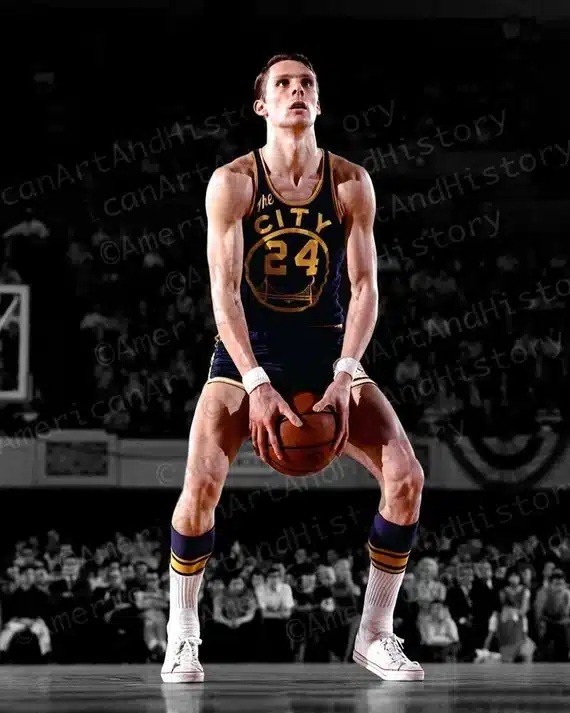
Barry’s underhand free throw sometimes drew laughs, but he had little reason to change it. He retired with a 90.0% NBA free-throw percentage, the highest career mark in league history at the time. In 1978–79, he missed only nine attempts all season.
The technique wasn’t his only unusual quality. Barry could score from the perimeter, attack the basket, find teammates, and make defensive plays. He was also famously demanding. His competitiveness helped drive his teams, although his blunt personality sometimes caused friction with teammates and opponents.
It’s easy to focus on the shooting motion because it looks so different. Yet his accuracy is a reminder that an effective technique doesn’t have to look fashionable, and his broader game explains why he remained valuable beyond his highest-scoring seasons.
His Final Seasons and Lasting Legacy
Barry spent his final two NBA seasons with the Houston Rockets, retiring in 1980 after 14 professional seasons across the NBA and ABA. He finished with 25,279 combined NBA and ABA regular-season points and later worked in broadcasting, staying connected to the game after his playing days ended.
In 1987, he entered the Naismith Memorial Basketball Hall of Fame. He was also named to the NBA’s 75th Anniversary Team, recognition that placed his achievements alongside those of players from different eras.
Barry’s place in basketball history goes well beyond his unusual shooting technique. His 1975 championship, scoring records, and success across two professional leagues gave him a career that still stands out decades later.
Rick Barry’s Place in Basketball History
Barry’s career combined scoring titles in college and professional basketball, a controversial move to the ABA, and leadership of Golden State’s unexpected 1975 championship team. His underhand free throw remains instantly recognizable, but his achievements across the NCAA, NBA and ABA explain his lasting place in basketball history.