
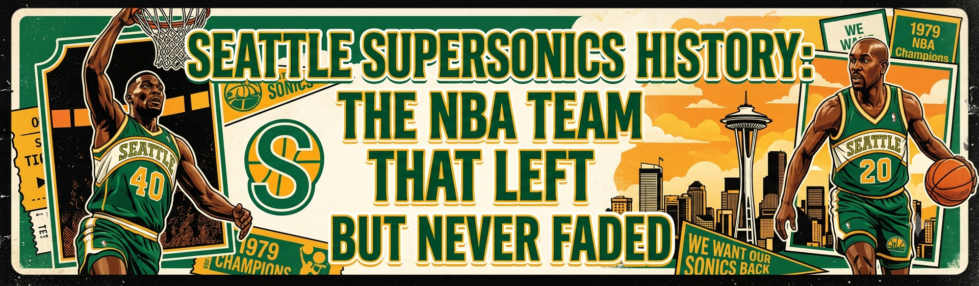
Basketball history usually favors the obvious monuments: Bill Russell’s Celtics, Jordan’s Bulls, Kobe and Shaq’s Lakers. The Seattle SuperSonics belong to a stranger category. They won, vanished, and somehow became louder after leaving. Their story is not only about a 1979 championship or a 2008 relocation. It is about what a franchise means when the schedule moves away, but the memory refuses to follow. The Seattle SuperSonics’ history is a testament to an enduring legacy.
A Jet-Age Name Before the NBA Became a Global Machine
The SuperSonics arrived in 1967, when Seattle wanted a team that matched its industrial confidence. The name came from the city’s aviation identity and the Boeing supersonic transport project, which made it feel less like a mascot and more like a civic mood. The NBA was not yet the polished entertainment giant it later became, so expansion teams had room to invent their own mythology.
That mythology mattered. Green and gold did not just identify a uniform; they gave Seattle basketball a visual language. The old Seattle Center Coliseum helped, too. It was not a luxury arena built for corporate separation. It was a loud civic room where a new basketball city could hear itself forming.
Lenny Wilkens Built a Champion Without Needing a Superteam
The 1979 SuperSonics were not remembered for overwhelming the league with glamour. They won because Lenny Wilkens built a disciplined defensive team that addressed the previous year’s failures. Seattle had lost the 1978 NBA Finals to the Washington Bullets in seven games, then returned in 1979 and beat the same opponent in five.
That reversal gives the championship its weight. Gus Williams brought scoring pressure, Jack Sikma stretched the geometry of the frontcourt, and Dennis Johnson turned defense into a nightly argument. Johnson became Finals MVP after averaging 22.6 points per game in the series, but the bigger point was tactical. Seattle ranked as a defense-first champion before that label became fashionable.
The Payton-Kemp Years Made Failure Feel Electric
The 1990s Sonics are proof that team history is not only built by banners. Gary Payton and Shawn Kemp never brought Seattle another championship, yet their era may be the most replayed chapter in franchise history. Payton defended with menace, talked constantly, and gave the team a personality that could not be mistaken for anyone else’s. Kemp made transition basketball look violent and airborne.
Their 1995–96 team won 64 regular-season games and reached the NBA Finals against Michael Jordan’s Chicago Bulls. Losing to a 72-win Bulls team did not erase the season. It froze Seattle in a specific basketball image: KeyArena shaking, George Karl pacing, Payton pressing full court, Kemp attacking the rim before defenders had time to make a business decision.
The Business Around Team Memory Became Part of the Sport
Modern basketball history no longer lives only in old box scores. It moves across documentaries, archive sites, podcasts, jersey drops, social accounts, betting content, and affiliate media. A fan who reads about the 1979 Sonics might later compare futures markets, watch old Finals footage, buy a throwback jersey, or follow a creator explaining how franchise relocation changes a city’s sports economy.
That is where sports storytelling and commercial infrastructure now overlap. For publishers covering betting audiences, the MelBet affiliate program can sit inside a broader sports-media model built around analytics, referral tracking, campaign performance, and audience segmentation. It is not the same as writing team history, and it should not distort historical coverage. But a serious publisher can separate editorial value from monetization mechanics when the surrounding block explains how partnerships work, how traffic is measured, and why sports audiences behave differently during major events, anniversaries, rivalries, and playoff runs.
Relocation Turned a Franchise Into an Open Wound
The painful part of the SuperSonics story is not that teams relocate. American sports history is full of movement. The sharper wound is that Seattle had already proved it could be an NBA city. The Sonics had a title, stars, sellout memories, and four decades of identity before the franchise moved to Oklahoma City and became the Thunder in 2008.
Howard Schultz’s sale to Clay Bennett’s ownership group in 2006 changed the franchise’s direction. Arena politics then became the language of loss. By the time the team left, the debate was no longer only about basketball operations. It was about public money, private ownership, lease agreements, civic trust, and whether fans have any real protection when a team’s legal owner chooses a different market.
Oklahoma City’s Rise Made the Memory Even More Complicated
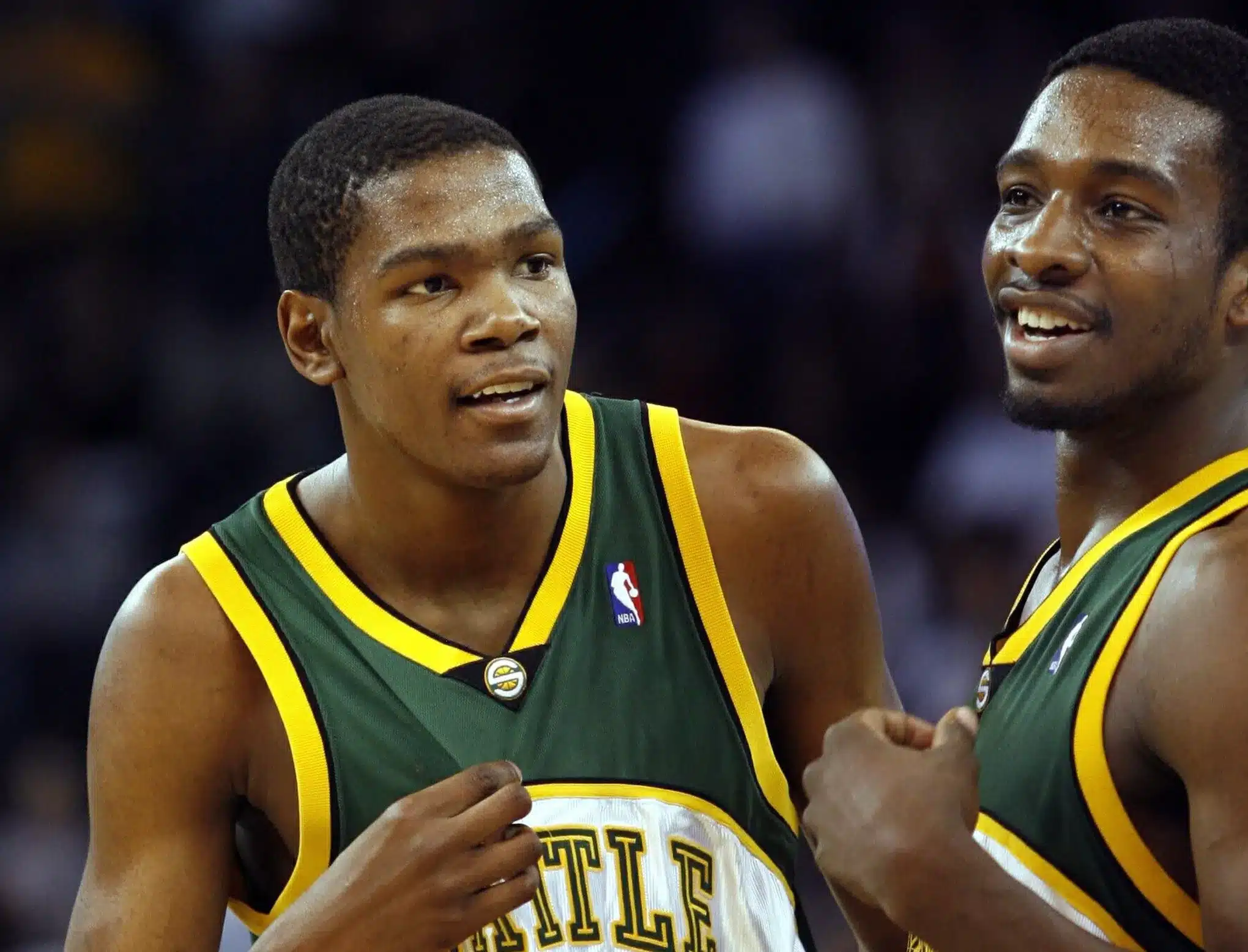
The Thunder did not become irrelevant after relocation. That is what makes the story harder. Kevin Durant, Russell Westbrook, James Harden, Shai Gilgeous-Alexander, and other stars gave Oklahoma City its own basketball identity. The Thunder’s success created a second emotional archive attached to the same franchise line.
For Seattle fans, that creates an uncomfortable split. The official franchise history can connect Seattle and Oklahoma City, but culture does not obey paperwork cleanly. A box score may place the 1979 and modern Thunder seasons into a single continuous record. A Seattle fan may see it differently. The trophies, colors, retired numbers, and nickname still carry local meaning that cannot be transferred by changing the address on the league map.
Why the Sonics Still Feel Present
The SuperSonics endure because their absence has structure. Fans can name the arena, the colors, the players, the Finals years, the ownership sequence, and the relocation timeline. That is more than nostalgia. It is a complete sports identity waiting in suspended animation.
A forgotten team disappears quietly. The Sonics never did. Every expansion rumor, every throwback jersey, every Gary Payton interview, and every discussion about NBA cities brings them back into the room. Their history works because it remains unfinished, and unfinished team histories often hold more power than neat dynasties with closed chapters.