
The AFC (American Football Conference) and the NFC (National Football Conference) make up the National Football League (NFL). Each of these conferences has 16 teams in the United States, with four in each division; North, East, South, and West. The top six teams from either conference will play against each other, and the last undefeated team in each conference will play against each other in the Superbowl.
These two conferences are basically what make the NFL and the Superbowl happen. They are both American football conferences, and they are the foundation blocks of the NFL, the leading sports game in America.
It is no surprise that these two conferences are so important, with how loved the NFL is in the states, the two conferences that make this happen are very key. The NFL is the most-watched sport in the USA, and it is also the most bet on as well, with bettors spending millions or more every year betting on this sport in betting shops or on sites such as Fanduel.
No one can deny that the AFC and NFC are extremely important to the football industry, but how many of us actually know how they came into being, or any of their history? Do we ever truly know what the difference is between the two?
It’s time we all found out.
What are the differences between the NFC and AFC?
These two conferences are what make the NFL and Superbowl and functioning American Football competition. On one hand, we have the AFC. The American Football Conference is one of the two conferences of the NFL, this and its counterpart the NFC each contain 16 teams, which makes up the 32 teams in the NFL.
Let’s have a look at the stats of these two conferences. In the AFC they have 21 Superbowl championships whereas the NFC has 24. They each have teams with high value, with the NFC having the team with the highest value- The Dallas Cowboys which is also the most valuable team in the NFL. The most valuable team in the AFC is the New England Patriots. However, The New England Patriots have more titles than the Dallas Cowboys.
Both of these conferences came into being during 1970 at the time of the NFL/AFL merger.
Now, before we jump into the deep history of these teams, let’s clear up which conference has which teams.
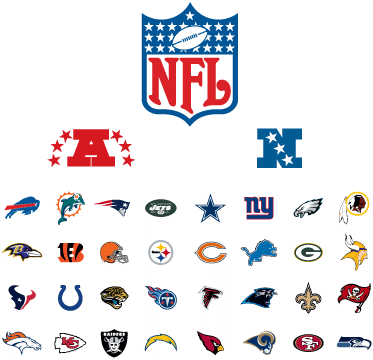
AFC
North
- Baltimore Ravens, Cincinnati Bengals, Cleveland Browns, Pittsburgh Steelers
East
- Buffalo Bills, Miami Dolphins, New England Patriots, New York Jets
South
- Houston Texans, Indianapolis Colts, Jacksonville Jaguars, Tennessee Titans
West
- Denver Broncos, Kansas City Chiefs, Oakland Raiders, San Diego Chargers
NFC
North
- Chicago Bears, Detroit Lions, Green Bay Packers, Minnesota Vikings
East
- Dallas Cowboys, New York Giants, Philadelphia Eagles, Washington Redskins
South
- Atlanta Falcons, Carolina Panthers, New Orleans Saints, Tampa Bay Buccaneers
West
- Arizona Cardinals, Los Angeles Rams, San Francisco 49ers, Seattle Seahawks
A brief history of AFC and NFC
The AFC and NFC were both brought into existence in 1970 during the merging of the two football leagues, the American Football League, and the National Football League. The NFL has existed since 1920, but the AFL was only established in 1959 by a group of expansion team owners who were refused entrance into the NFL.
These two leagues used to be direct competitors for 10 years before they merged, and this merger created a unified National Football League split into two conferences. After this, the AFC was dominant in terms of wins in the Superbowl through the 70s, until the NFC won a long stretch of non-stop wins throughout the 80s and mid-’90s.
For the last ten years, these two conferences have been more evenly matched in terms of their wins, while there have been occasional shifts and then rebalancing of the divisions and conferences over the years in order to accommodate new teams.
AFC History
The AFC came into being when the NFL and AFL merged in 1970, and it had ten teams when it was created which were the former teams of the AFL, as well as the NFL’s Cleveland Browns, Pittsburgh Steelers, and the Baltimore Colts. The Eastern and Western divisions were more intact than their North and South divisions upon its beginning.
Since 1970 five expansion teams joined the AFC and two left, making an overall total of teams 16. When the Seattle Seahawks and Tampa Bay Buccaneers joining in ‘76 they were temporarily placed in both the NFC and AFC, however, this only lasted one season before they switched conferences, where the Seahawks returned to the NFC in 2002. Then in 1995, the Jacksonville Jaguars joined the AFC.
There was some relocation controversy of the Browns and a new AFC franchise called the Baltimore Ravens was established in ‘96, however, the Browns were re-established in ‘99. Then the Houston Texans were added in ‘02.
NFC History
The NFC merged with the AFC in 1970. While all the former AFL teams as well as the Cleveland Browns, Pittsburgh Steelers, Baltimore Colts formed up the AFC, the remaining 13 formed the NFC. The NFL Capitol, Central, and Coastal divisions became the NFC East, Central, and West divisions.
Yet, team owners struggled to agree to a plan on how they could align the clubs in the NFC. Eventually, they narrowed it down to five options, and they picked by choosing one from a glass bowl. The 3rd plan was picked, and it is still the same to this day, bar a few adjustments due to expansion teams joining.
Three expansion teams have joined since this merger, like the AFC, making the total 16. When the Seahawks and Buccaneers joined the league in ‘76 they were placed in the AFC and NFC respectively for a single season, but then the Seahawks returned to the NFC as a result of a realignment. Then in 1995, the Carolina Panthers joined.
Since 2002 no NFC team has made a back-to-back Superbowl appearance. However, this does keep things more even between the two conferences.
___